

Space ETFs overlap more than most investors expect. Names like Space Exploration Technologies Corp (privately held but represented through pre-IPO structures on some funds), Rocket Lab, AST SpaceMobile, and Viasat show up as top-10 holdings across nearly every fund in the category, though the weight each gets varies enormously. Some funds, like the Amplify Top 10™ Space ETF, deliberately concentrate around a handful of names, while others spread exposure across 60 or more companies. Before you act on any single weighting, check the "as of" date on the issuer's holdings page or the fund's most recent SEC filing. Snapshots go stale fast in a sector this volatile.
TL;DR:
- The most concentrated space ETFs like WARP can have over 24% exposure to a single company such as Space Exploration Technologies Corp, increasing single-stock risk.
- Diversified funds like UFO spread risk across dozens of companies, making their holdings more stable but potentially less focused on industry leaders.
- Overlap in top holdings does not imply redundancy; differences in weighting levels significantly impact individual fund risk profiles.
- Holdings data can become outdated rapidly in this volatile sector, so always verify the "as of" date and source before acting.
- Use real-time tracking tools to monitor holdings changes, as sector catalysts can quickly alter fund exposures between official updates.
Table of Contents
- Comparing Space ETF Holdings Side by Side
- The Stocks That Keep Reappearing (and What They Do)
- How to Verify Space ETF Holdings Before You Trust Them
- Where to Pull Verified Holdings Data
- Why Holdings Overlap Doesn't Mean Redundancy
- Track Space ETF Holdings Changes Without Refreshing a Spreadsheet
- Sources
- FAQ
Comparing Space ETF Holdings Side by Side
Seven ETFs dominate the space investing conversation right now, and they take genuinely different approaches to portfolio construction. The gap between the most concentrated fund and the most diversified one is wide enough to change your risk profile entirely, depending on which you pick.
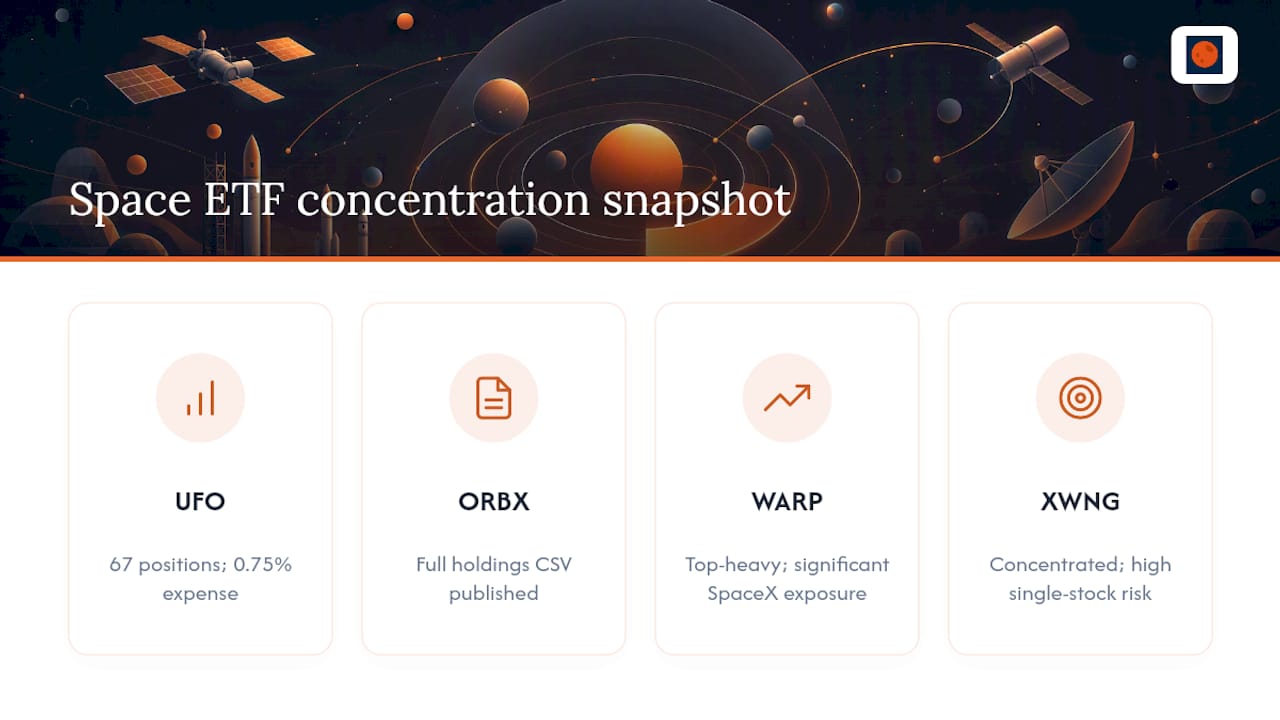
The Procure Space ETF (UFO) holds 67 positions with a 0.75% expense ratio, spreading risk across satellite operators, launch companies, and ground infrastructure firms. Its top-10 list includes Garmin, Trimble, Viasat, Sirius XM, EchoStar, AST SpaceMobile, Iridium, Globalstar, and Rocket Lab. That breadth means no single name typically dominates the fund the way concentrated products allow.
The Global X Space Tech ETF (ORBX) takes a different tilt, weighting heavily toward Space Exploration Technologies, AST SpaceMobile, Rocket Lab, Viasat, and MDA. ORBX publishes a full downloadable holdings CSV, which makes it one of the easier funds to audit line by line.
VanEck's Space ETF (WARP) runs noticeably more top-heavy. Recent daily holdings data has shown Space Exploration Technologies Corp exposure at a significant portion of net assets in a single snapshot, alongside Rocket Lab, Viasat, Iridium, and Globalstar. That kind of concentration can swing fund performance sharply on company-specific news.
XWNG, GALX, MARS, and NASA round out the group, each with a distinct design philosophy:
The pattern that matters most: funds built as thematic indexes (UFO, ORBX) dilute single-stock risk across dozens of names, while purpose-built concentrated products like XWNG amplify it. Insight from Procure's own fund structure confirms this divide is intentional, not incidental, across the category.
The Stocks That Keep Reappearing (and What They Do)
A small cluster of companies anchors nearly every space ETF on the market, regardless of how the fund is constructed. Recognizing their industry role helps you understand what you're actually buying exposure to.
- Space Exploration Technologies Corp operates as a launch provider and satellite network operator, appearing in ORBX's top holdings and reportedly reaching close to 24% of net assets in a recent WARP snapshot.
- Rocket Lab functions as a launch provider with growing satellite manufacturing operations, showing up across UFO, ORBX, and MARS holdings lists.
- AST SpaceMobile builds direct-to-device satellite communications infrastructure and ranks among the top holdings in both UFO and ORBX.
- Viasat provides satellite communications and connectivity services, a fixture in UFO, ORBX, and WARP portfolios alike.
- Iridium and Globalstar both operate satellite communications networks and show up repeatedly as mid-to-large weights across multiple funds.
Weight ranges for these recurring names vary widely fund to fund. A single company might have a modest weighting in a broadly diversified ETF like UFO and a substantially higher weighting in a concentrated, top-heavy fund like WARP. That spread creates real single-stock risk: a launch failure, a regulatory setback, or a missed earnings report at one of these companies can move an entire fund's return, not just a sliver of it.
Pro Tip: Don't assume two "space ETFs" give you similar exposure just because they share a sector label. Pull the top-10 lists side by side before you buy. A fund weighted 24% toward one launch provider behaves nothing like one spread across 67 positions.
How to Verify Space ETF Holdings Before You Trust Them
Holdings data goes stale fast in this sector, so build a quick verification habit before acting on any number you see in a screenshot or a secondhand comparison chart.
- Confirm the "as of" date and source. Pull the number straight from the issuer's daily holdings page or CSV, not a cached screenshot from a blog post or forum thread.
- Measure concentration. Add up the top-5 and top-10 weights. A fund where the top five names account for more than half the portfolio behaves very differently than one where they account for 20%.
- Compare sector and country weights to your thesis. If you want exposure to launch providers specifically, check whether the fund is actually weighted there or spread thin across communications and IT services instead.
- Watch for red flags. Large derivative or swap exposure, inconsistent "as of" dates across sections of the same fact sheet, unusually small AUM, or high turnover all signal a fund that may not behave the way its name suggests. Amplify's own documentation notes that XWNG's weightings can reflect positions held through total return swaps rather than direct stock ownership, which changes how you should interpret its top-10 list.
Pro Tip: If a fund's AUM sits well below $50 million, treat its holdings percentages as more volatile day to day. Small funds can see outsized weight swings from a single large buy or redemption order.
Where to Pull Verified Holdings Data
The most reliable hierarchy runs from issuer to regulator, in that order. Start with the fund's own daily holdings page or downloadable CSV, since that's the freshest source available. Cross-check against the published fund fact sheet, which usually updates monthly and includes expense ratio and AUM alongside top holdings. For the highest level of verification, SEC filings offer machine-readable holdings data that can confirm what the issuer discloses on its own site.
| Source type | Update frequency | Best use |
|---|---|---|
| Issuer daily holdings / CSV | Daily | Real-time weight checks |
| Fund fact sheet | Monthly | Expense ratio, AUM, sector breakdown |
| SEC filings | Periodic (quarterly/annual) | Independent verification |
An example SEC holdings filing shows how granular this data can get once you go straight to the regulatory source. If two sources disagree, check whether one reports holdings net of swaps or on a different NAV date. Aggregator sites like ETFdb's space ETF list are useful for scanning the category quickly, but they can lag issuer updates by days.
Why Holdings Overlap Doesn't Mean Redundancy
Most investors assume that if two space ETFs share seven of their top-10 names, buying both is pointless. That's not quite right, and it's worth pushing back on.
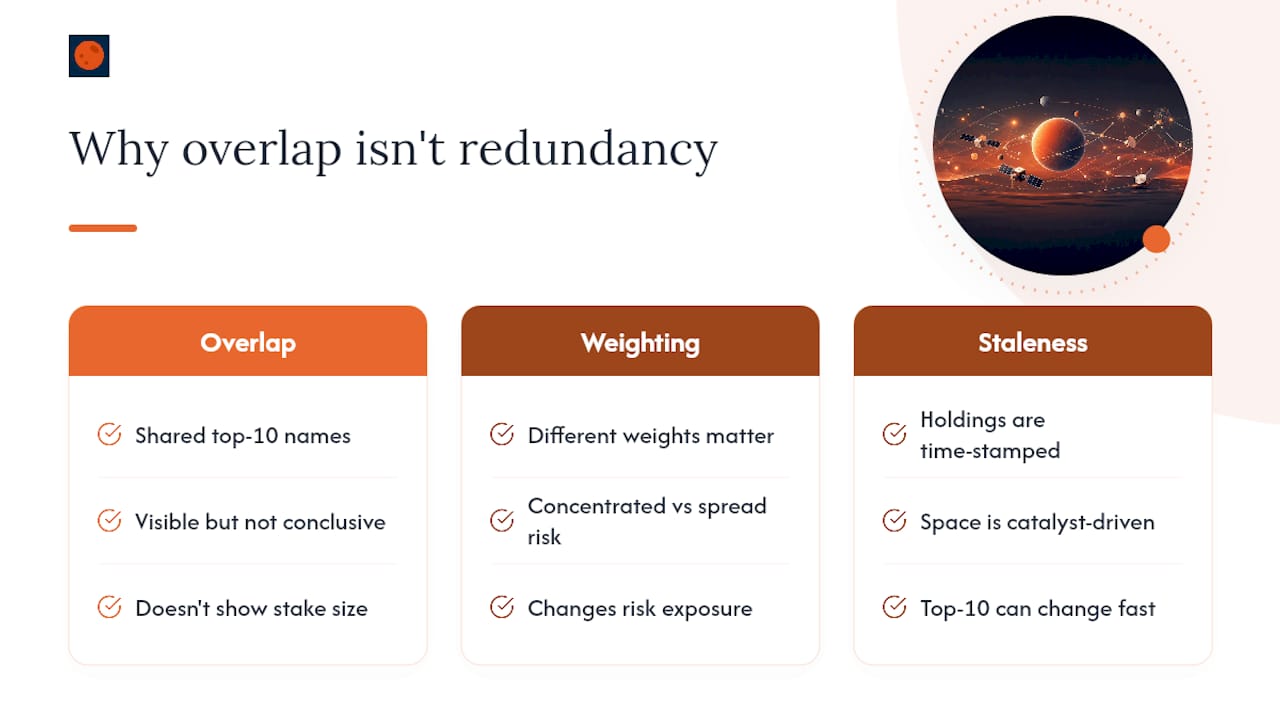
The overlap in names is real, but the weighting differences are where the actual investment decision lives. A fund like UFO holding Rocket Lab at a relatively small weight, spread among many other names, delivers a fundamentally different risk exposure than a concentrated fund holding the same stock at several times that weight. You're not choosing between "space ETF A" and "space ETF B" as interchangeable wrappers. You're choosing how much conviction you want in a handful of names versus how much diversification you want across an entire emerging industry.
The bigger risk most retail investors overlook isn't overlap. It's staleness. Space is a catalyst-driven sector, launch delays, contract wins, regulatory shifts, and a fund's top-10 list from three months ago can already misrepresent its current exposure. Treat every holdings page like a photograph, not a live feed, unless you've confirmed the timestamp yourself.
— DaDevMate
Track Space ETF Holdings Changes Without Refreshing a Spreadsheet
Checking issuer pages one by one every time a launch fails or a contract gets announced is not a sustainable habit for anyone tracking this sector seriously. A dashboard is available specifically for investors who need real-time visibility into the companies these ETFs hold, without waiting on monthly fact sheets to catch up.

The free tier gives you access to core research tools, and the More Stuff landing area hosts embeds you can drop straight into your own tracking setup, including a live ticker-tape embed and a sector heatmap embed for visualizing how the whole space stock universe is moving at a glance. Pair those with Martianalpha's launch calendar and AI-generated company summaries, and you get a running picture of the exact catalysts that move ETF holdings weights week to week. Head to Martianalpha to set up your dashboard and start watching the names behind these funds in real time.
Sources
FAQ
What Is the Best ETF for Space Stocks?
There's no single "best" fund. It depends on whether you want broad diversification, which the Procure Space ETF (UFO) offers across 67 holdings, or concentrated conviction in fewer names, which funds like XWNG or WARP provide. Match the fund's concentration level to your own risk tolerance rather than chasing whichever fund performed best last quarter.
Which ETF Is Better, NASA or UFO?
The two funds take different approaches: UFO spreads exposure across 67 holdings with a 0.75% expense ratio, favoring diversification, while the Tema Space Innovators ETF (NASA) applies its own selection methodology to a narrower innovator-focused universe. Compare their top-10 lists and expense ratios directly on each issuer's page before deciding which fits your thesis.
What Are the Top 10 Holdings of the ETF NASA?
The Tema Space Innovators ETF's exact top-10 list isn't standardized in this comparison, since Tema doesn't publish the same CSV-level detail as some peer funds. Check Tema's own fund page directly for the current "as of" date and full holdings breakdown before making any allocation decision.
What Are Some Promising Space Stocks to Watch?
Names that recur across multiple ETF top-10 lists include Space Exploration Technologies Corp, Rocket Lab, AST SpaceMobile, Viasat, Iridium, and Globalstar, spanning launch, satellite communications, and infrastructure roles. Their appearance across funds like UFO and ORBX signals broad institutional conviction, though individual weight and risk vary sharply by fund.
How Often Do Space ETF Holdings Change?
Holdings can shift daily as issuers rebalance, though most funds only trigger significant weight changes around catalyst events like launches, contract awards, or earnings surprises. Always check the issuer's daily holdings page rather than relying on a fact sheet that may be weeks old.